 Add to Chrome
 Add to Firefox
 Add to Edge
Robust Asynchronous Planning via Auto-Formalization
May 31, 2026
LLMs can plan by either generating action sequences directly as a Planner or translating tasks into domain specific language for an external solver as a Formalizer. While most real-world tasks are asynchronous with non-uniform durations, concurrency, and execution-time constraints, existing benchmarks hardly cover them. We unify these asynchronous planning challenges under a single formulation and introduce the first three benchmarks that address each at scale. We conclude that the choice of formal representation primarily determines whether planning scales: as dependency graphs grow from 5 to 100 actions, Planner collapses from 96% to 5% plan accuracy and PDDL2.1 Formalizer from 13% to 0%, while CP-SAT Formalizer averages 94% and still achieves 83% at 100 actions. Faithfulness diagnostics show that PDDL2.1's predicate-based planning representation becomes brittle compared to general constraint satisfaction programs, when LLMs must keep predicates, effects, and goals consistent. Execution-time updates of planning constraints further degrade performance sharply (Planner 23.9%, PDDL2.1 0.7%, CP-SAT 46.1%), but a state-aware repair strategy that updates only event-induced constraints recovers CP-SAT Formalizer to 84.5%.

Skill Reuse as Compression in Agentic RL
May 29, 2026Large language model agents trained with reinforcement learning (RL) often learn brittle, task-specific shortcuts. We hypothesize that agents generalize better when their successful trajectories are structurally compressible, decomposed into a small set of reusable abstract patterns. To formalize this, we introduce ReuseRL, which grounds agentic RL in the Minimum Description Length (MDL) principle. ReuseRL extracts a shared skill dictionary from successful trajectories and augments the RL objective with a segmentation cost, explicitly penalizing idiosyncratic behaviors that encode poorly. We prove a PAC-Bayes generalization bound for this compression penalty. Across ALFWorld, TextWorld-Cooking, and Countdown-Stepwise, ReuseRL improves in- and out-of-distribution success over vanilla GRPO and strong round-length baselines.
VisAnalog: A Diagnostic Suite for Visual Concept Transfer on Natural Images
May 22, 2026A useful test of visual concept learning is not just whether a model can recognize a concept in a single image, but whether it can preserve and manipulate concept-level properties under transformation and transfer them to new scenes. We introduce VisAnalog, a controlled suite for this setting on natural images. Each example instantiates $A\!:\!B::C\!:\,?$: images $B$ and a hidden target image $D$ are produced by applying the same deterministic transformation sequence to source images $A$ and $C$. Given $A$, $B$, and $C$, a model must answer a multiple-choice question about $D$. The benchmark contains 617 human-validated questions spanning one- to four-step transformations such as zoom, quadrant swap, rotation, flip, and hue rotation. Across strong proprietary and open-source VLMs, end-to-end accuracy is substantially lower than oracle accuracy when $D$ is directly shown, and degrades sharply as transformation depth increases, while human performance remains near the ceiling. A program-conditioned evaluation further separates failures of relation inference from failures of transformation application, showing that inferring the visual relation from $A \rightarrow B$ is the dominant bottleneck, with additional application errors emerging on harder multi-step cases. The dataset is publicly available at https://huggingface.co/datasets/zli99/VisAnalog.
Vocabulary Dropout for Curriculum Diversity in LLM Co-Evolution
Apr 03, 2026Co-evolutionary self-play, where one language model generates problems and another solves them, promises autonomous curriculum learning without human supervision. In practice, the proposer quickly converges to a narrow distribution of problems that satisfy the reward function. This diversity collapse renders the curriculum uninformative for the solver, stalling the co-evolutionary loop. We introduce vocabulary dropout, a random mask applied to the proposer's output logits during both policy training and curriculum generation, as a lightweight mechanism to sustain diversity. The mask is hard and non-stationary, preventing the proposer from locking into fixed token sequences. Training Qwen3-4B and Qwen3-8B on mathematical reasoning via R-Zero, we find that vocabulary dropout sustains proposer diversity across lexical, semantic, and functional metrics throughout training, and yields solver improvements averaging +4.4 points at 8B, with the largest gains on competition-level benchmarks. Our findings suggest that explicit action-space constraints, analogous to the structural role that game rules play in classical self-play, can help sustain productive co-evolution in language. Vocabulary dropout is one simple instantiation of this principle.
Reliable Use of Lemmas via Eligibility Reasoning and Section$-$Aware Reinforcement Learning
Feb 01, 2026Recent large language models (LLMs) perform strongly on mathematical benchmarks yet often misapply lemmas, importing conclusions without validating assumptions. We formalize lemma$-$judging as a structured prediction task: given a statement and a candidate lemma, the model must output a precondition check and a conclusion$-$utility check, from which a usefulness decision is derived. We present RULES, which encodes this specification via a two$-$section output and trains with reinforcement learning plus section$-$aware loss masking to assign penalty to the section responsible for errors. Training and evaluation draw on diverse natural language and formal proof corpora; robustness is assessed with a held$-$out perturbation suite; and end$-$to$-$end evaluation spans competition$-$style, perturbation$-$aligned, and theorem$-$based problems across various LLMs. Results show consistent in$-$domain gains over both a vanilla model and a single$-$label RL baseline, larger improvements on applicability$-$breaking perturbations, and parity or modest gains on end$-$to$-$end tasks; ablations indicate that the two$-$section outputs and section$-$aware reinforcement are both necessary for robustness.
CORE: Concept-Oriented Reinforcement for Bridging the Definition-Application Gap in Mathematical Reasoning
Dec 21, 2025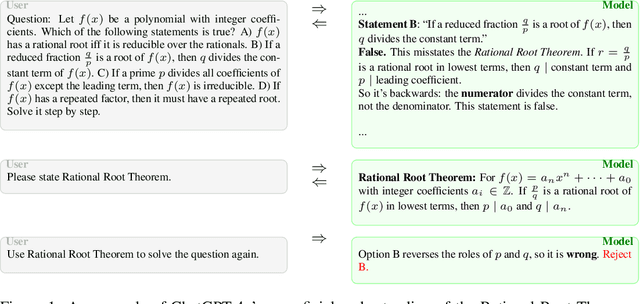

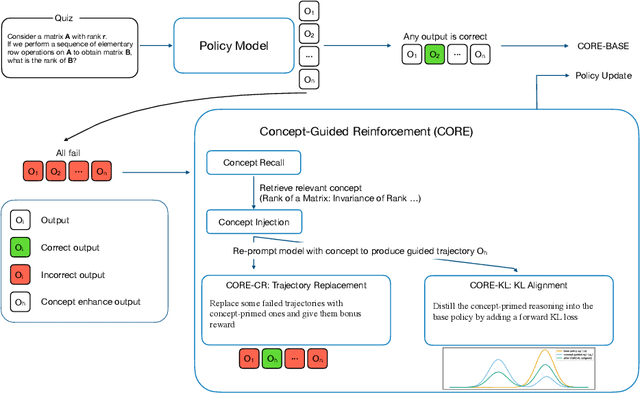
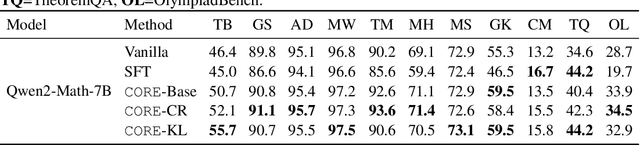
Large language models (LLMs) often solve challenging math exercises yet fail to apply the concept right when the problem requires genuine understanding. Popular Reinforcement Learning with Verifiable Rewards (RLVR) pipelines reinforce final answers but provide little fine-grained conceptual signal, so models improve at pattern reuse rather than conceptual applications. We introduce CORE (Concept-Oriented REinforcement), an RL training framework that turns explicit concepts into a controllable supervision signal. Starting from a high-quality, low-contamination textbook resource that links verifiable exercises to concise concept descriptions, we run a sanity probe showing LLMs can restate definitions but fail concept-linked quizzes, quantifying the conceptual reasoning gap. CORE then (i) synthesizes concept-aligned quizzes, (ii) injects brief concept snippets during rollouts to elicit concept-primed trajectories, and (iii) reinforces conceptual reasoning via trajectory replacement after group failures, a lightweight forward-KL constraint that aligns unguided with concept-primed policies, or standard GRPO directly on concept-aligned quizzes. Across several models, CORE delivers consistent gains over vanilla and SFT baselines on both in-domain concept-exercise suites and diverse out-of-domain math benchmarks. CORE unifies direct training on concept-aligned quizzes and concept-injected rollouts under outcome regularization. It provides fine-grained conceptual supervision that bridges problem-solving competence and genuine conceptual reasoning, while remaining algorithm- and verifier-agnostic.
Unbiased Visual Reasoning with Controlled Visual Inputs
Dec 19, 2025End-to-end Vision-language Models (VLMs) often answer visual questions by exploiting spurious correlations instead of causal visual evidence, and can become more shortcut-prone when fine-tuned. We introduce VISTA (Visual-Information Separation for Text-based Analysis), a modular framework that decouples perception from reasoning via an explicit information bottleneck. A frozen VLM sensor is restricted to short, objective perception queries, while a text-only LLM reasoner decomposes each question, plans queries, and aggregates visual facts in natural language. This controlled interface defines a reward-aligned environment for training unbiased visual reasoning with reinforcement learning. Instantiated with Qwen2.5-VL and Llama3.2-Vision sensors, and trained with GRPO from only 641 curated multi-step questions, VISTA significantly improves robustness to real-world spurious correlations on SpuriVerse (+16.29% with Qwen-2.5-VL-7B and +6.77% with Llama-3.2-Vision-11B), while remaining competitive on MMVP and a balanced SeedBench subset. VISTA transfers robustly across unseen VLM sensors and is able to recognize and recover from VLM perception failures. Human analysis further shows that VISTA's reasoning traces are more neutral, less reliant on spurious attributes, and more explicitly grounded in visual evidence than end-to-end VLM baselines.
ArenaBencher: Automatic Benchmark Evolution via Multi-Model Competitive Evaluation
Oct 09, 2025


Benchmarks are central to measuring the capabilities of large language models and guiding model development, yet widespread data leakage from pretraining corpora undermines their validity. Models can match memorized content rather than demonstrate true generalization, which inflates scores, distorts cross-model comparisons, and misrepresents progress. We introduce ArenaBencher, a model-agnostic framework for automatic benchmark evolution that updates test cases while preserving comparability. Given an existing benchmark and a diverse pool of models to be evaluated, ArenaBencher infers the core ability of each test case, generates candidate question-answer pairs that preserve the original objective, verifies correctness and intent with an LLM as a judge, and aggregates feedback from multiple models to select candidates that expose shared weaknesses. The process runs iteratively with in-context demonstrations that steer generation toward more challenging and diagnostic cases. We apply ArenaBencher to math problem solving, commonsense reasoning, and safety domains and show that it produces verified, diverse, and fair updates that uncover new failure modes, increase difficulty while preserving test objective alignment, and improve model separability. The framework provides a scalable path to continuously evolve benchmarks in step with the rapid progress of foundation models.
ThinkTuning: Instilling Cognitive Reflections without Distillation
Aug 11, 2025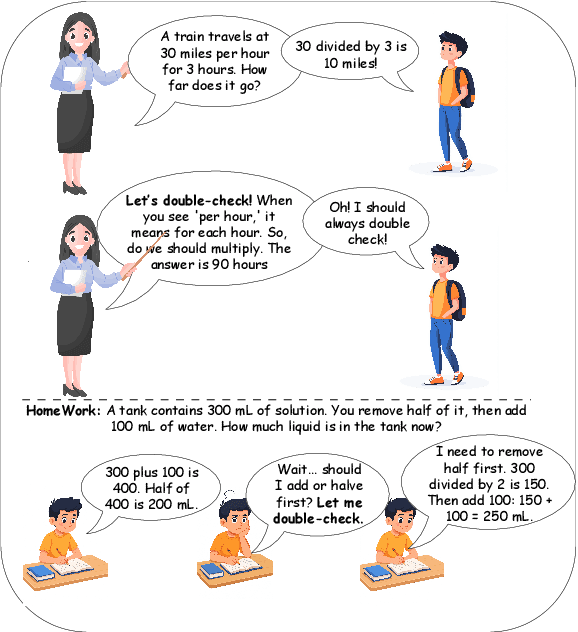
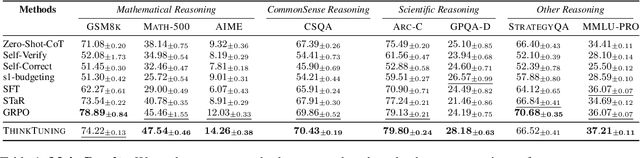
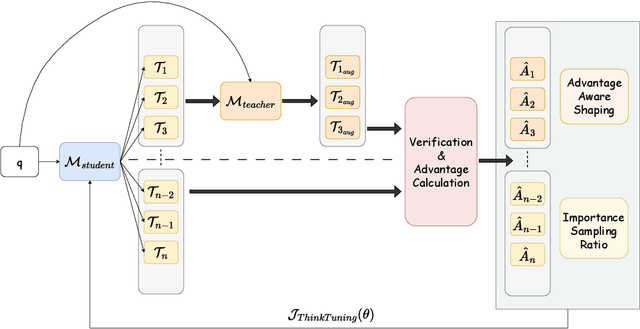
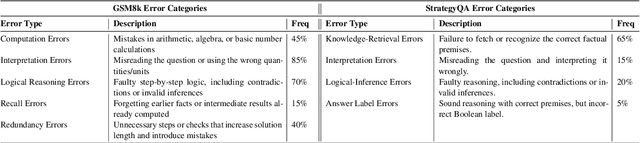
Recent advances in test-time scaling have led to the emergence of thinking LLMs that exhibit self-reflective behaviors and multi-step reasoning. While RL drives this self-improvement paradigm, a recent study (Gandhi et al., 2025) shows that RL alone does not truly instill these new reasoning abilities - it merely draws out behaviors already present in the base models. This raises a question: How can we train the models that don't exhibit such thinking behavior to develop it in the first place? To this end, we propose ThinkTuning, a GRPO-based interactive training approach where we augment the rollouts of a student model with the guidance from a teacher model. A simple idea from classroom practice inspires our method: a teacher poses a problem, lets the student try an answer, then gives corrective feedback -- enough to point the mind in the right direction and then show the solution. Each piece of feedback reshapes the student's thoughts, leading them to arrive at the correct solution. Similarly, we find that this type of implicit supervision through feedback from a teacher model of the same size improves the reasoning capabilities of the student model. In particular, on average, our method shows a 3.85% improvement over zero-shot baselines across benchmarks, and on MATH-500, AIME and GPQA-Diamond it shows 2.08%, 2.23% and 3.99% improvements over the vanilla-GRPO baseline. Source code is available at https://github.com/3rdAT/ThinkTuning.
CC-LEARN: Cohort-based Consistency Learning
Jun 18, 2025Large language models excel at many tasks but still struggle with consistent, robust reasoning. We introduce Cohort-based Consistency Learning (CC-Learn), a reinforcement learning framework that improves the reliability of LLM reasoning by training on cohorts of similar questions derived from shared programmatic abstractions. To enforce cohort-level consistency, we define a composite objective combining cohort accuracy, a retrieval bonus for effective problem decomposition, and a rejection penalty for trivial or invalid lookups that reinforcement learning can directly optimize, unlike supervised fine-tuning. Optimizing this reward guides the model to adopt uniform reasoning patterns across all cohort members. Experiments on challenging reasoning benchmarks (including ARC-Challenge and StrategyQA) show that CC-Learn boosts both accuracy and reasoning stability over pretrained and SFT baselines. These results demonstrate that cohort-level RL effectively enhances reasoning consistency in LLMs.